
If you’re planning to pursue your undergraduate studies abroad — especially in the USA or Canada — you’ve likely come across the ACT exam. As Brainerrsoverseas, a leading study-abroad consultancy in Delhi, we guide thousands of students every year in selecting the right standardized tests. Understanding what the ACT exam is, who should take it, and how it impacts your admissions is essential for planning your study-abroad journey.
This comprehensive guide explains the ACT exam, its format, eligibility, scoring, and how it helps you secure admission to top international universities.
What Is ACT?
ACT stands for American College Testing. It is a standardized test used for undergraduate admissions by universities in the United States, Canada, and several other countries.
The ACT exam evaluates a student’s readiness for college-level academics by testing skills in:
- English
- Mathematics
- Reading
- Science
There is also an optional Writing section (essay) that some universities may require.
The ACT can be taken in a computer-based or paper-based format depending on the test center. It is one of the most accepted exams for bachelor’s-level admissions abroad.
Components of the ACT Exam
The ACT exam includes four main sections and one optional section. Here’s what each section tests:
| Section | Skills Tested |
| English | Grammar, punctuation, sentence structure, rhetorical skills |
| Mathematics | Algebra, geometry, trigonometry, analytical math |
| Reading | Comprehension, interpretation, ideas, themes |
| Science | Scientific reasoning, data analysis, problem-solving |
| Writing (Optional) | Essay writing, argument development, clarity of thought |
The Writing section is not compulsory, but some universities recommend or require it. Always check the requirements of your target colleges before deciding.
ACT Exam Pattern and Timing
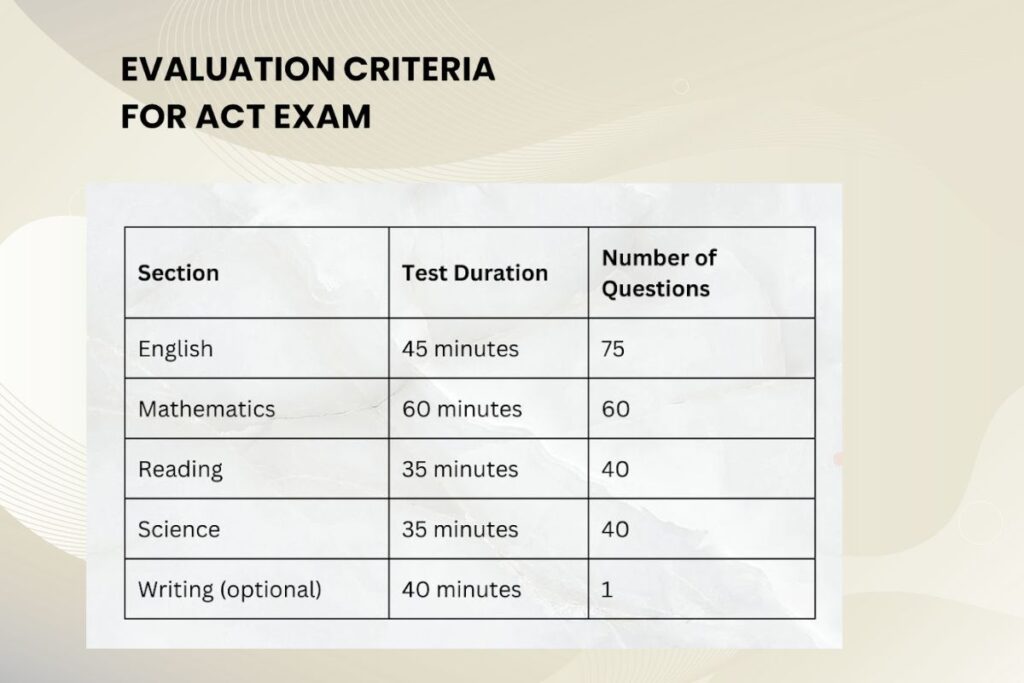
The ACT is known for its structured format and strict timing. Below is the test pattern followed globally:
| Section | No. of Questions | Time |
| English | 75 MCQs | 45 minutes |
| Mathematics | 60 MCQs | 60 minutes |
| Reading | 40 MCQs | 35 minutes |
| Science | 40 MCQs | 35 minutes |
| Writing (Optional) | 1 essay | 40 minutes |
- Total duration without writing: 2 hours 55 minutes
- Total duration with writing: 3 hours 35 minutes
The ACT follows a multiple-choice format for all sections except Writing. There is no negative marking, making it advantageous to attempt every question.
ACT Scoring System
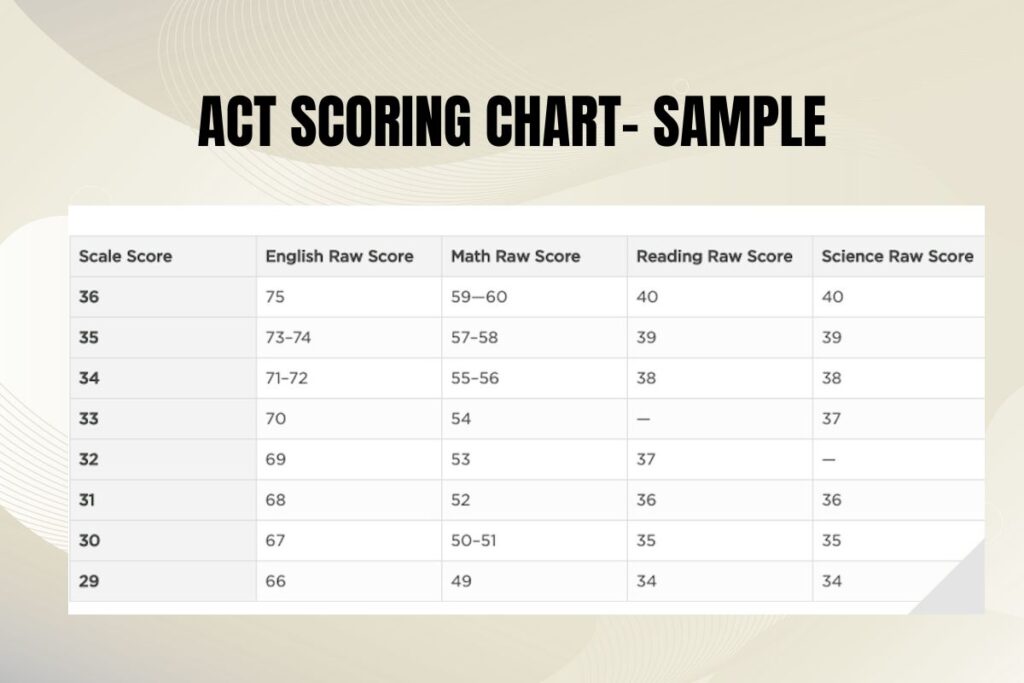
The ACT scoring system is simple yet powerful for college admissions.
- Each section (English, Math, Reading, Science) is scored on a scale of 1 to 36.
- Your composite ACT score is the average of the four section scores.
- The Writing test score (if taken) is separate and does not affect the composite score.
A score above 30 is generally considered excellent and can boost your chances of getting into top international universities.
Who Needs to Take the ACT Exam?
The ACT is primarily for students applying for undergraduate courses abroad. You should take the ACT if:
- You are applying to U.S. universities for a bachelor’s degree.
- You are applying to selected Canadian universities that accept ACT scores.
- You want to strengthen your profile with a standardized test score.
- You prefer ACT over SAT due to its structure, content, or scoring style.
- You want flexibility since ACT offers multiple test dates annually.
Eligibility Highlights
- No official age or grade limit
- Most students take the ACT in Grade 11 or Grade 12
- You can take the test regardless of your educational board (CBSE/ICSE/IB/State Board)
When Can You Take the ACT?
The ACT is conducted multiple times a year, allowing students to choose dates that match their preparation schedule and university deadlines.
Students often attempt the ACT:
- At the end of Class 11
- In Class 12
- After Class 12 for gap-year admissions
Since there is no penalty for retakes, many students appear two or more times to maximize their scores.
Why the ACT Matters for International Students

The ACT offers several benefits to Indian students aiming to study abroad:
1. Widely Accepted
Almost all U.S. universities and many Canadian institutions accept ACT scores for undergraduate admissions.
2. Holistic Skill Assessment
ACT tests a wide range of abilities — reading, reasoning, math, science, language — helping universities understand your academic readiness.
3. No Negative Marking
Guessing is encouraged, making it easier to score higher.
4. Flexible Test Dates
You can select a date that matches your preparation timeline.
5. Enhances Your Application
A good ACT score boosts your chances of admission, scholarships, and merit-based awards.
At Brainerrsoverseas, we help you understand whether the ACT aligns with your university goals and how it fits into your profile-building strategy.
How Brainerrsoverseas Helps You With ACT Planning
As a trusted study abroad consultancy in Delhi, Brainerrsoverseas offers complete guidance for your ACT journey:
- Personalized counselling to decide between ACT & SAT
- Guidance on ACT exam format, preparation strategy, and timelines
- Assistance with test registration and documentation
- Score-target planning based on your dream universities
- Complete support with U.S. & Canadian university applications
- Expert advice on scholarships linked to ACT scores
Our goal is to ensure that your ACT results strengthen your profile and improve your chances of securing admission to top universities.
FAQs About ACT Exam
What is the full form of ACT?
ACT stands for American College Testing.
Is ACT required for U.S. universities?
Most U.S. universities accept ACT scores for undergraduate admissions.
What is a good ACT score?
A composite score above 30 is considered excellent.
Does the ACT have negative marking?
No, there is no negative marking.
Do I need to take the Writing section?
Only if your target universities require it.
How many times can I take the ACT?
There is no limit; you can retake it multiple times.
Which countries accept ACT scores?
Primarily the USA, Canada, and some international universities.
When should I take the ACT?
Preferably in Class 11 or 12, or before application deadlines.
Is the ACT harder than the SAT?
It depends on the student. ACT includes a Science section, while SAT does not.
Is ACT accepted in Canada?
Many Canadian universities accept ACT scores.
Is the ACT an online or paper test?
It can be either, depending on the test center.
What skills does the ACT test?
English, Math, Reading, Science, and optional Writing.
What is the duration of the ACT?
2 hours 55 minutes (without writing) and 3 hours 35 minutes (with writing).
Can ACT improve scholarship chances?
Yes, many universities offer merit scholarships based on ACT scores.
Does Brainerrsoverseas help with ACT guidance?
Yes, we provide complete ACT counselling, planning, and admissions support.